
Roller Replacement · Oak Ridge North
Roller Replacement for Oak Ridge North's Older Door Stock
Oak Ridge North homes mostly went up around 1977, over a decade before Spring's median build year - older steel rollers and tighter track tolerances change the job. Spring Garage Door Co runs the 7-mile call.
Stocked Parts
Oak Ridge North's housing runs older than most of the area we cover out of Spring - the median build year here lands around 1977, more than a decade ahead of the 1989 median across the wider service territory. That gap matters for rollers specifically. Doors from the late 1970s were built with narrower track gauges and steel rollers riding on plain stem bearings, not the sealed nylon rollers that became standard once builders moved into the 1980s and 90s stock that makes up most of the rest of our area. We carry both: 7-ball and 10-ball sealed nylon rollers for newer sections, and steel replacements sized for the older stem and track combinations that still show up on original doors here that were never upgraded. If a door's track has been re-hung or widened over the years, we measure before we quote rather than assume the stock size fits. One honest limit: on a handful of original 1970s doors, the stem is a size we don't carry on the truck, and that's a special-order part with a short wait, not a same-day fix.
How We Fix It
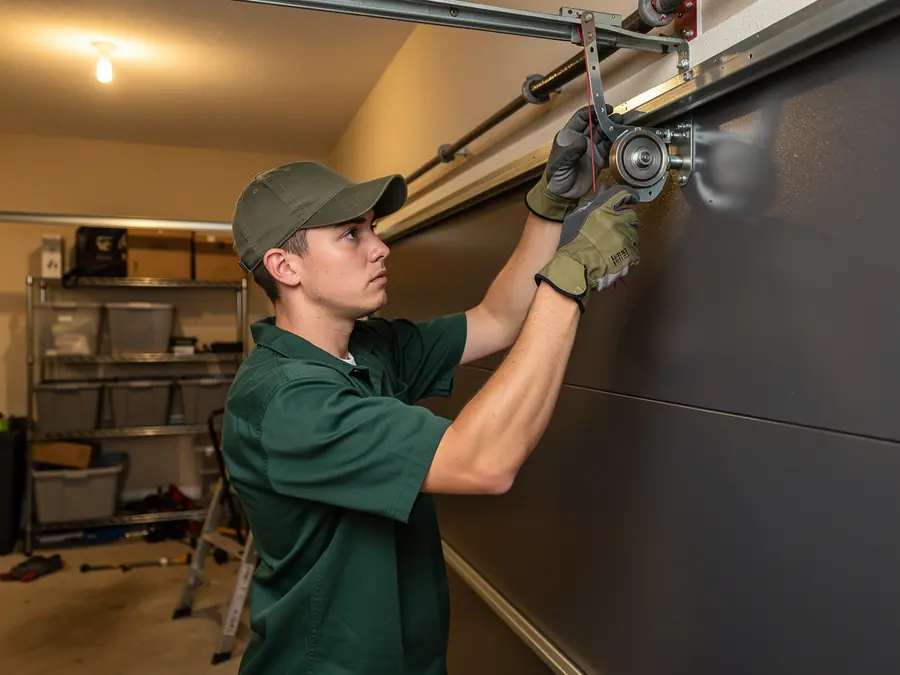
We pull the door down with vise grip clamps locking the track below the bottom roller, release spring tension, and walk the rollers out one at a time rather than dropping the whole section. On the older stem-and-track doors common in Oak Ridge North, the bracket holes have often worn oval from decades of a stiff roller dragging rather than rolling, so we check bracket condition before reusing it. A roller swap on a bracket that's egg-shaped just fails again in a year. We true up the track gap while the door's apart - tracks installed in the late 70s were often set tighter than current spec allows, and that tightness is usually why the rollers wore out early to begin with. Every roller gets lubricated with the right grease for steel-on-steel versus sealed nylon; using the wrong one on a sealed roller does nothing and wastes the trip.
What Can Go Wrong
The failure pattern we see most in this pocket of the service area is a cracked or flat-spotted steel roller that's been grinding against a track edge for months before anyone notices the noise. On a 1977-era door, that wear often pairs with a bent track from the roller binding rather than rolling smoothly - swap the roller alone and the new one wears the same way within weeks. We also see brackets pulled loose from the door panel itself on older wood or early steel sections, since the original fasteners weren't rated for the load once a roller starts dragging. None of that shows up as a roller problem at first glance; it shows up as noise, and the roller is usually the last thing to actually break. We open with inspecting the whole roller-and-track path, not just the part that's obviously cracked.
How It Shows Up
A grinding or scraping sound as the door travels - steadier and louder than a simple squeak - is the usual first sign on the older doors common to this area. You might notice the door hesitates or jerks at the same spot in the track every time, which points to a specific bad roller rather than general wear. On houses here built before the track-widening that came standard in later construction, a worn roller can also cause the door to rub against the weatherstripping or frame on one side, since there's less clearance to absorb the play. If the door comes off track entirely during travel, stop opening it - that's a job that needs an in-person look, not a phone diagnosis, since a dropped section on a narrow 1970s track can bend the rail further with every attempt to force it back.
What You Pay
We don't post a flat roller price here because the job in Oak Ridge North often isn't a pure roller swap - once track gauge and bracket wear from an older door come into play, the quote reflects whatever parts actually need replacing, not a one-size number. What we can tell you up front: households in this area report a median income well above the wider service territory's $82,810, and most doors we're called to here are original or close to it, which usually means more than a one-roller fix once we're inside the track. We quote on-site after inspection, and we'll tell you plainly if the door's wear pattern points to a full roller set instead of spot-replacing the one that's loud.
FAQ
Questions about this
Why would my rollers wear out faster than a newer house nearby?
If your house dates to the 1970s build wave common in Oak Ridge North, you likely have steel rollers on a narrower track than houses built in the 80s or 90s. Steel-on-steel wears faster than sealed nylon, and a tighter original track gauge adds friction that accelerates it further.
Do you keep a truck stocked near Oak Ridge North?
No - we run the call from Spring, about 7 miles out. We carry common roller sizes on every truck, but an older stem size specific to original 1970s hardware sometimes needs to be special-ordered rather than pulled off the shelf same-day.
Can I just replace the one noisy roller?
Sometimes, yes. But on older doors we often find the bracket or track has worn alongside the roller, and replacing one part while the other stays worn just brings the noise back. We inspect the full path before quoting a single-roller fix.
Tell us what your door is doing.
We serve Spring, TX and nearby communities. Every job starts with a diagnosis, so you know what failed before any work begins.